
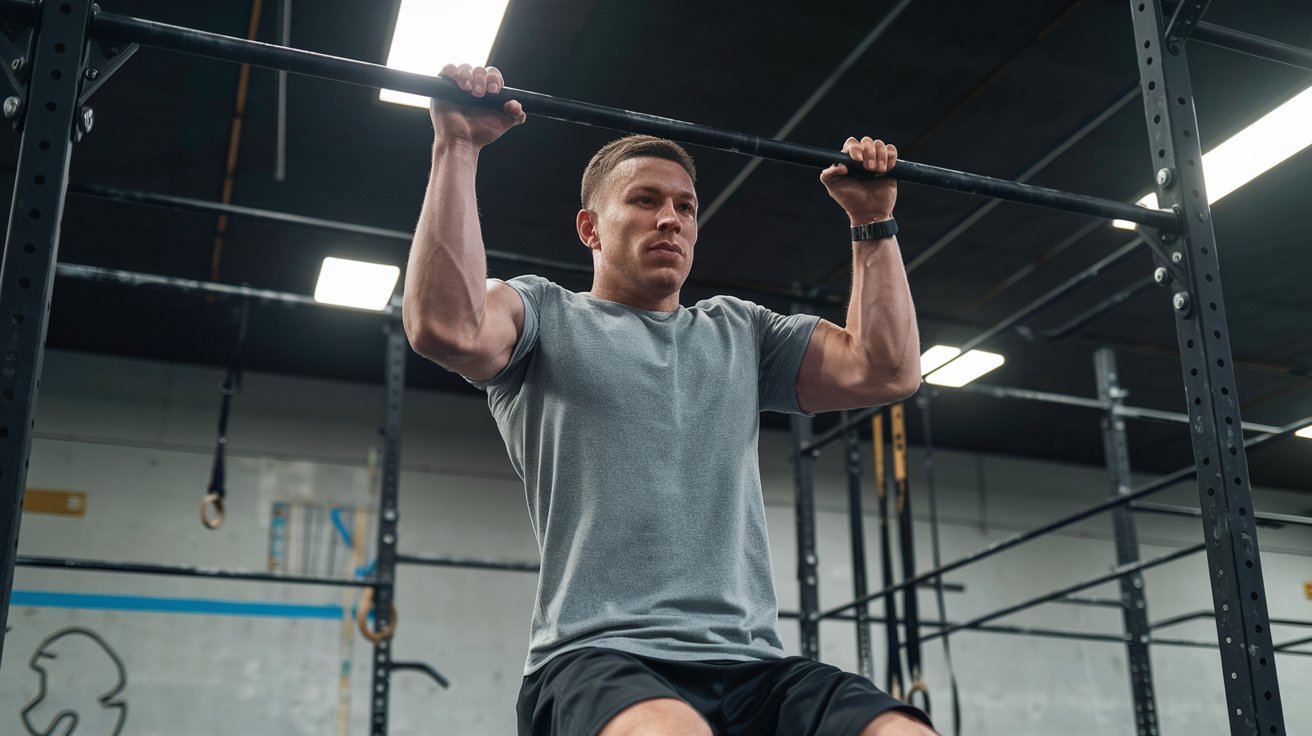
Learning how to work up to a pull up requires a systematic approach that builds the specific strength needed for this challenging exercise. Most beginners need 4-8 weeks of consistent training to achieve their first pull-up, progressing through specific exercises that target the back, arms, and core muscles essential for pulling your body weight up to the bar.
Why Most People Cannot Do Pull-Ups Initially
Pull-ups demand significant upper body strength that many adults simply haven’t developed through daily activities. According to 2024 fitness studies, approximately 85% of American adults cannot perform a single unassisted pull-up due to insufficient strength in the latissimus dorsi, rhomboids, and biceps muscles. The movement requires you to lift your entire body weight using primarily your back and arm muscles.
The primary reason people struggle with pull-ups is the strength-to-weight ratio challenge. Unlike push-ups where you lift approximately 65% of your body weight, pull-ups require lifting 100% of your body weight against gravity. Additionally, modern sedentary lifestyles contribute to weak posterior chain muscles, making the pulling motion particularly difficult for beginners.
Building Foundation Strength for Pull-Ups
Before attempting pull-ups, you must develop adequate foundation strength through preparatory exercises. Research shows that individuals need to perform at least 10 inverted rows and hold a dead hang for 30 seconds before progressing to assisted pull-ups. This foundational phase typically takes 2-4 weeks of consistent training.
Focus on strengthening your grip strength first, as this often becomes the limiting factor. Dead hangs from a pull-up bar help build both grip endurance and shoulder stability. Start with 15-20 second holds and gradually work up to 45-60 seconds. Simultaneously, incorporate inverted rows using a barbell or suspension trainer to target the same muscle groups used in pull-ups.
Essential Dead Hang Progression
The dead hang forms the cornerstone of pull-up preparation, developing grip strength and shoulder stability simultaneously. Begin with passive hangs where you simply grip the bar and let your body weight stretch your shoulders and lats. Progress from 15-second holds to 60-second holds over 2-3 weeks, performing 3-5 sets during each workout session.
Inverted Row Mastery
Inverted rows teach the pulling pattern essential for pull-ups while allowing you to adjust difficulty by changing your body angle. Set a barbell in a rack at chest height, lie underneath, and pull your chest to the bar. Start with your body at a 45-degree angle and gradually work toward a more horizontal position as you build strength.
Assisted Pull-Up Techniques and Progressions
Assisted pull-ups bridge the gap between foundation exercises and unassisted pull-ups by reducing the amount of body weight you need to lift. Band-assisted pull-ups using resistance bands provide variable assistance, with maximum help at the bottom of the movement where you’re weakest. Choose bands that allow you to complete 5-8 repetitions with proper form.
Partner-assisted pull-ups offer another effective progression where someone holds your feet or legs to reduce the load. This method allows for real-time assistance adjustment throughout the movement. Machine-assisted pull-ups provide consistent support but may not translate as effectively to unassisted pull-ups due to the fixed assistance pattern.
Resistance Band Selection and Setup
Choose resistance bands based on your current strength level and body weight. Heavier individuals typically need thicker bands providing 40-60 pounds of assistance, while lighter individuals may succeed with 20-40 pounds of assistance. Loop the band over the pull-up bar and place your knees or feet in the band for support during the movement.
Proper Assisted Pull-Up Form
Maintain strict pull-up form even when using assistance. Keep your core engaged, shoulders pulled down and back, and avoid excessive swinging or kipping motions. Focus on pulling your chest toward the bar rather than trying to get your chin over it, as this promotes better muscle activation and joint positioning.
Negative Pull-Up Training Method
Negative pull-ups involve starting at the top position and slowly lowering yourself down, emphasizing the eccentric (lowering) portion of the movement. This technique allows you to handle more weight than you can pull concentrically and builds tremendous strength. Use a box or jump to reach the top position, then lower yourself over 3-5 seconds.
Negative training produces significant strength gains because your muscles can handle 20-30% more weight during the lowering phase. Perform negative pull-ups 2-3 times per week, focusing on 3-5 repetitions with slow, controlled descents. This method often produces faster results than assisted pull-ups alone, with most trainees seeing improvement within 2-3 weeks.
Essential Accessory Exercises for Pull-Up Success
Supplementary exercises target specific muscle groups and movement patterns that directly transfer to pull-up strength. Lat pulldowns using various grips help build the primary pulling muscles, while face pulls and reverse flies strengthen the rear deltoids and rhomboids. These exercises should comprise 30-40% of your pull-up training program.
Bicep curls and hammer curls strengthen the arm muscles essential for the pulling motion, while plank variations build the core stability needed to maintain proper body position during pull-ups. Incorporate these exercises 2-3 times per week, focusing on moderate weights and higher repetitions to build muscular endurance.
Lat Pulldown Variations
Use lat pulldowns with wide grip, narrow grip, and neutral grip positions to target different aspects of your pulling muscles. Aim to pulldown 80-90% of your body weight for 8-10 repetitions before expecting success with unassisted pull-ups. Focus on pulling the bar to your upper chest rather than behind your neck.
Core Strengthening for Pull-Ups
A strong core prevents energy leaks and maintains proper body alignment during pull-ups. Hollow body holds, planks, and hanging knee raises specifically target the muscles used to stabilize your torso during the pull-up movement. Perform these exercises 3-4 times per week for optimal results.
Creating Your Pull-Up Training Schedule
An effective pull-up training schedule balances work and recovery while providing progressive overload. Train pull-up specific movements 3-4 times per week, alternating between high-volume assistance work and low-volume strength focus days. Allow at least one day of rest between intense pull-up sessions to prevent overuse injuries.
Structure your weekly routine with two heavy days focusing on negative pull-ups and band-assisted work, plus two lighter days emphasizing dead hangs and accessory exercises. This approach prevents plateau and maintains consistent progress toward your first unassisted pull-up.
Timeline Expectations for Pull-Up Success
Most beginners require 6-12 weeks of consistent training to achieve their first unassisted pull-up, depending on starting strength level, body weight, and training consistency. Individuals with some upper body training background may succeed in 4-6 weeks, while those starting from minimal fitness levels may need 12-16 weeks.
Factors affecting timeline include body weight, age, and training frequency. Heavier individuals face greater challenges due to the increased load, while older adults may require longer adaptation periods. Consistent training 4-5 times per week typically produces faster results than sporadic training sessions spread throughout the month.
Common Mistakes That Slow Progress
The biggest mistake beginners make is attempting full pull-ups too early, before building adequate foundation strength. This leads to frustration and potentially poor movement patterns that become difficult to correct later. Focus on the progression steps rather than rushing to the end goal.
Another common error involves neglecting grip strength development. Many trainees can generate enough pulling force but cannot maintain their grip on the bar long enough to complete the movement. Incorporate specific grip training exercises like farmer’s walks and plate pinches into your routine for comprehensive development.
Related video about how to work up to a pull up
This video complements the article information with a practical visual demonstration.
Most asked questions about how to work up to a pull up
How do I build strength to do a pull-up?
Build pull-up strength through progressive exercises including dead hangs, inverted rows, assisted pull-ups, and negative pull-ups. Start with foundation exercises and gradually increase difficulty over 6-12 weeks. Consistency with 3-4 training sessions per week produces optimal results.
How long does it take to build up to a pull-up?
Most beginners need 6-12 weeks of consistent training to achieve their first pull-up. Factors like starting fitness level, body weight, and training frequency affect timeline. Some may succeed in 4-6 weeks while others require 12-16 weeks depending on individual circumstances.
Why am I not strong enough to do a pull-up?
Pull-ups require lifting 100% of your body weight using back, arm, and core muscles that many people haven’t adequately developed. Modern sedentary lifestyles contribute to weak posterior chain muscles, making this movement particularly challenging without specific training.
What exercises help build pull-up strength?
Key exercises include dead hangs for grip strength, inverted rows for pulling pattern, assisted pull-ups with bands, negative pull-ups for eccentric strength, lat pulldowns for primary muscles, and core exercises for stability. Combine these exercises in a structured progression program.
How often should I train for pull-ups?
Train pull-up specific movements 3-4 times per week with at least one rest day between intense sessions. Alternate between heavy days focusing on negatives and assisted work, and lighter days emphasizing dead hangs and accessory exercises for optimal progress and recovery.
Can I do pull-ups if I’m overweight?
Yes, but it may take longer due to the increased load. Focus heavily on assisted variations, build exceptional grip strength, and consider combining pull-up training with gradual weight loss for faster progress. Band-assisted and machine-assisted pull-ups work particularly well for heavier individuals.
| Training Phase | Duration | Key Focus |
|---|---|---|
| Foundation Building | 2-4 weeks | Dead hangs and inverted rows |
| Assisted Training | 3-6 weeks | Band-assisted and negative pull-ups |
| First Pull-Up | 6-12 weeks | Unassisted pull-up achievement |

