
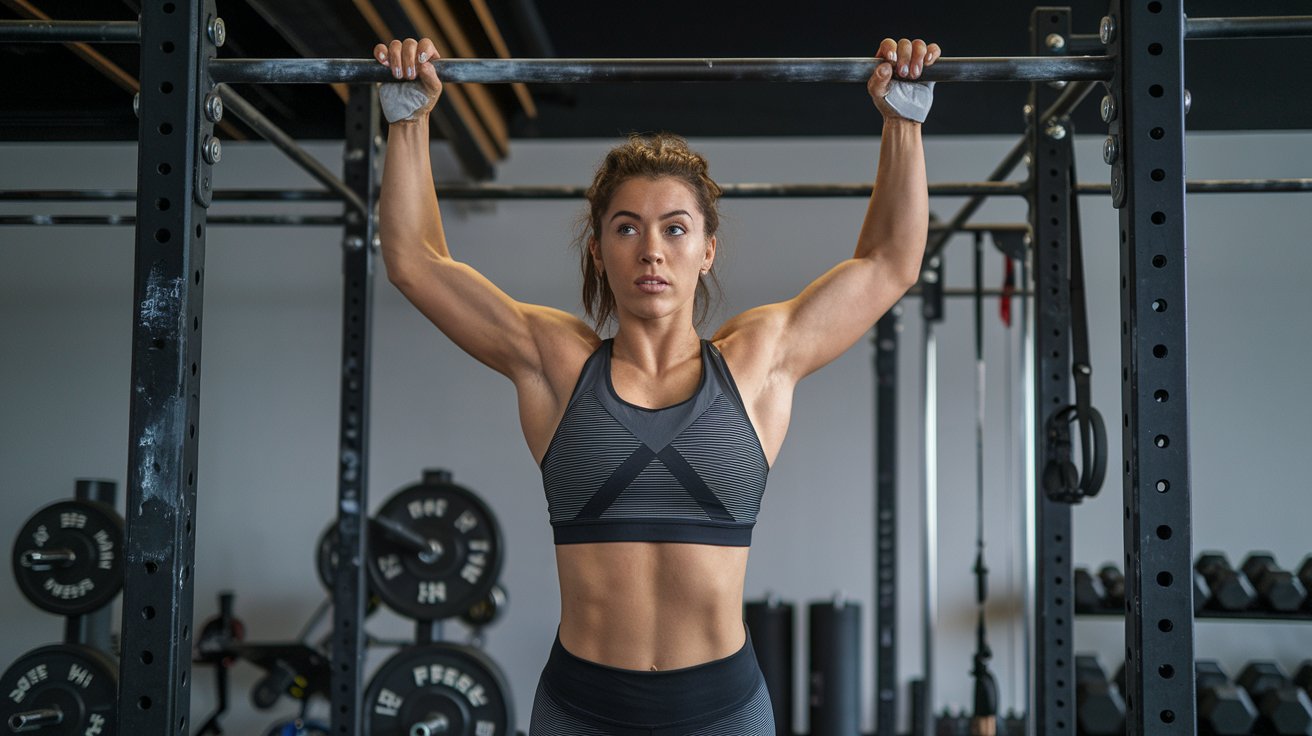
Learning how to get better at pull-ups for females requires understanding that women face unique challenges due to naturally lower upper body strength and different muscle fiber composition. However, with the right progressive training approach, proper form, and consistent practice, any woman can master this challenging exercise and build impressive upper body strength.
Why Pull-Ups Are Challenging for Women
Understanding why pull-ups are so hard for women is essential before starting your training journey. Research from the American Council on Exercise shows that women typically have 40-60% less upper body strength than men, making pull-ups particularly challenging. Women naturally carry more body fat percentage and have different hormonal profiles that affect muscle development, specifically in the lats, biceps, and rhomboids needed for pull-up strength.
Additionally, women often have longer limbs relative to their torso, creating a mechanical disadvantage during the pulling motion. The grip strength disparity between men and women also plays a significant role, as female grip strength averages 30-35% less than males. However, these challenges are absolutely surmountable with proper training techniques and progressive overload principles.
Essential Muscles and Movement Patterns
Pull-ups work multiple muscle groups simultaneously, making them one of the most effective upper body exercises. The primary muscles engaged include the latissimus dorsi (lats), which provide the main pulling power, the rhomboids and middle trapezius for scapular retraction, and the biceps for elbow flexion. Secondary muscles include the rear deltoids, lower trapezius, and core muscles for stability during the movement.
Understanding proper pull-up form for females involves initiating the movement from the lats rather than just pulling with the arms. Start from a dead hang with arms fully extended, engage your core, and pull your shoulder blades down and back before beginning the upward motion. This technique ensures maximum muscle recruitment and reduces injury risk while building the foundation for stronger pull-ups.
Progressive Training Methods for Beginners
The most effective approach for building pull-up strength for women involves progressive overload through assisted variations. Start with assisted pull-ups using resistance bands, assisted pull-up machines, or a training partner. Band-assisted pull-ups are particularly effective because they provide the most assistance at the bottom of the movement where you’re weakest, gradually reducing help as you reach the top position.
Dead hangs are crucial for developing the grip strength necessary for pull-ups. Begin with 10-15 second holds and progressively work up to 60+ seconds. Negative pull-ups, where you jump or step up to the top position and slowly lower yourself down, are excellent for building eccentric strength. Control the descent for 3-5 seconds to maximize muscle engagement and strength gains.
Band-Assisted Pull-Up Progression
Use different resistance band strengths to create a systematic progression. Start with the thickest band that allows you to complete 8-12 repetitions with proper form. As you build strength for pull-ups, gradually move to lighter bands. Focus on maintaining consistent tempo and full range of motion rather than rushing through repetitions. This method allows for precise load management and consistent progress tracking.
Negative Pull-Up Technique
Master the negative phase by stepping or jumping to the top position with your chin over the bar. Slowly lower yourself down over 3-5 seconds, focusing on controlling the movement with your lats and maintaining proper shoulder position. This eccentric training builds tremendous strength and teaches proper movement patterns essential for completing full pull-ups.
Intermediate to Advanced Training Strategies
Once you can perform 3-5 unassisted pull-ups, focus on increasing pull-up repetitions through structured programming. The pyramid method involves performing sets of increasing then decreasing repetitions (1-2-3-2-1) with adequate rest between sets. This approach allows for higher total volume while managing fatigue effectively.
Implementing different grip variations challenges muscles differently and prevents plateaus. Wide-grip pull-ups emphasize the lats more heavily, while chin-ups (underhand grip) recruit the biceps more significantly. Neutral grip pull-ups are often easier on the shoulders and can help females build pull-up strength more comfortably. Rotate between grips every 2-3 weeks to ensure balanced development.
Volume and Frequency Programming
Optimal pull-up training frequency for women is typically 3-4 times per week with at least one day of rest between sessions. Start with 3-5 sets of maximum repetitions minus 1-2 reps to avoid failure. As your strength improves, increase volume by adding sets before adding repetitions to individual sets.
Adding Weighted Pull-Ups
Once you can perform 10-12 bodyweight pull-ups consistently, consider adding external weight to continue progressing. Start with 5-10 pounds using a weight belt or holding a dumbbell between your feet. Weighted pull-ups for females significantly increase strength and muscle mass, leading to easier bodyweight repetitions.
Complementary Exercises and Accessory Work
Supporting your pull-up training with accessory exercises accelerates progress and addresses weak points. Bent-over rows strengthen the same pulling muscles with external load, allowing for progressive overload. Lat pulldowns provide similar movement patterns while allowing precise weight selection for strength building.
Inverted rows using a barbell in a squat rack or suspension trainer work the same muscles with adjustable difficulty based on body angle. Face pulls target the rear deltoids and rhomboids, which are crucial for proper shoulder positioning during pull-ups. Include these exercises 2-3 times per week to support your pull-up progression for women.
Common Mistakes and Form Corrections
Many women struggle with pull-ups due to improper form rather than lack of strength. The most common mistake is initiating the movement with the arms instead of the back muscles. Always begin by pulling your shoulder blades down and back before bending your elbows. This engages the larger, stronger lat muscles and makes the movement more efficient.
Avoid using momentum or kipping motions, which reduce muscle activation and increase injury risk. Each repetition should be controlled and deliberate, with a brief pause at the top position where your chin clears the bar. Proper pull-up form also requires maintaining a neutral spine and engaged core throughout the entire movement to prevent unnecessary strain on the lower back.
Timeline and Realistic Expectations
The question “how long does it take for a girl to do a pull-up” depends on starting fitness level, training consistency, and individual factors. Complete beginners typically need 3-6 months of consistent training to perform their first unassisted pull-up. Women with some upper body strength background may achieve this goal in 6-12 weeks with proper programming.
Realistic milestones include achieving a 30-second dead hang within 2-4 weeks, completing negative pull-ups within 4-6 weeks, and performing assisted pull-ups with minimal assistance within 8-10 weeks. Remember that female pull-up standards vary significantly, and progress isn’t always linear. Focus on consistent improvement rather than comparing yourself to others.
Nutrition and Recovery for Pull-Up Success
Proper nutrition plays a crucial role in building strength for pull-ups. Adequate protein intake (0.8-1.2 grams per pound of body weight) supports muscle recovery and growth. Focus on complete proteins like lean meats, eggs, dairy, and plant-based combinations to provide all essential amino acids needed for muscle protein synthesis.
Recovery is equally important as training itself. Allow 48-72 hours between intense pull-up sessions to permit muscle adaptation. Quality sleep (7-9 hours nightly) is essential for hormone regulation, particularly growth hormone and testosterone, which support muscle development in women. Manage stress levels through meditation, yoga, or other relaxation techniques, as chronic stress can impede strength gains.
Injury Prevention and Safety Guidelines
Preventing injury during pull-up training for females requires attention to proper warm-up protocols and listening to your body’s signals. Always begin sessions with 5-10 minutes of general warm-up followed by specific shoulder and lat stretches. Arm circles, band pull-aparts, and light lat pulldowns prepare the muscles and joints for intense pulling movements.
Watch for warning signs of overuse injuries including persistent shoulder pain, elbow discomfort, or unusual fatigue. Golfer’s elbow and shoulder impingement are common issues when training volume increases too rapidly. If pain occurs, reduce training intensity and consider consulting a physical therapist or qualified trainer for movement assessment and corrective strategies.
Related video about how to get better at pull-ups for females
This video complements the article information with a practical visual demonstration.
Key Questions and Answers
Why is it so hard for a woman to do a pull-up?
Women typically have 40-60% less upper body strength than men due to hormonal differences, lower muscle mass in the arms and back, and different body composition with higher fat percentage. Additionally, women often have longer limbs relative to their torso, creating mechanical disadvantages. However, with proper training, these challenges are absolutely overcome-able.
How do I build strength to do pull-ups?
Start with assisted pull-ups using bands or machines, practice dead hangs for grip strength, and perform negative pull-ups to build eccentric strength. Include accessory exercises like bent-over rows, lat pulldowns, and inverted rows. Train 3-4 times per week with progressive overload and proper recovery between sessions.
How long does it take for a girl to do a pullup?
Complete beginners typically need 3-6 months of consistent training to perform their first unassisted pull-up. Women with existing upper body strength may achieve this in 6-12 weeks. Progress depends on starting fitness level, training consistency, body composition, and individual genetic factors.
How many pull-ups should a female be able to do?
Fitness standards vary, but 1-3 pull-ups is considered good for average women, 4-6 is very good, and 7+ is excellent. Elite female athletes may perform 15-20+ pull-ups. Focus on personal progress rather than comparing to others, as individual factors significantly influence performance capabilities.
What’s the difference between pull-ups and chin-ups for women?
Pull-ups use an overhand grip emphasizing the lats more, while chin-ups use an underhand grip recruiting more biceps. Chin-ups are typically easier for beginners due to increased bicep involvement. Both exercises are valuable for building upper body strength, and alternating between them provides balanced muscle development.
Should women add weight to pull-ups?
Once you can perform 10-12 bodyweight pull-ups consistently, adding 5-10 pounds can enhance strength gains. Weighted pull-ups increase muscle mass and make bodyweight repetitions feel easier. However, master proper form and build a solid foundation before progressing to weighted variations to prevent injury.
| Training Phase | Key Focus Areas | Expected Timeline |
|---|---|---|
| Beginner (Weeks 1-8) | Dead hangs, assisted pull-ups, negative reps | Build foundation strength |
| Intermediate (Weeks 9-16) | First unassisted pull-ups, form refinement | Achieve 1-3 consecutive reps |
| Advanced (Weeks 17+) | Volume increase, weighted variations | 6+ reps, advanced techniques |

